Bike Torque Wrench: Why Every Carbon Fiber Bike Desperately Needs One
My Trek Domane SL has been on an indoor trainer for three years. I rode it indoors occasionally, mostly on Zwift, until even that stopped. It has been collecting dust ever since.
When I decided to get it ready to ride again, the first thing I did was reach for my bike torque wrench. Not because I suspected anything was wrong. Because that is what you do with a carbon fiber bike.
Some of the fasteners were off spec. A bike that had not been ridden outdoors in three years, that had spent most of its life in a basement. Off spec.
That is why every carbon fiber bike owner needs a bike torque wrench.
Carbon Fiber Is Not Steel
Steel is forgiving. Aluminum is forgiving. Carbon fiber is not.
Over-torque a bolt on a carbon fiber frame and you can crack it. The damage is not always visible. The failure does not always happen immediately. Sometimes it happens on a descent at 35 miles per hour.
Under-torque and things move that should not move. A stem that is not properly torqued will slip under load. A seatpost clamp that is finger-tight will let the post rotate or drop mid-ride.
The torque specifications exist for a reason. A bike torque wrench is the only way to hit those specs consistently. It is not optional equipment on a carbon bike.
How Fasteners Lose Torque Indoors
This is the part that surprises people. If the bike never leaves the trainer, how do the fasteners back off?
Two ways.
First, vibration. Every pedal stroke creates vibration through the drivetrain. Every shift, every chain rotation over the cassette. It is less vibration than road riding but it accumulates over time. Three years of occasional Zwift sessions is enough to back a fastener off its spec.
Second, thermal cycling. The bike warms up when you ride and cools down when you stop. Metal expands and contracts with temperature. Over hundreds of cycles that process works fasteners loose, slowly and invisibly.
You do not know they have lost torque until you check with a bike torque wrench. That is the point.
The Bike Torque Wrench I Use
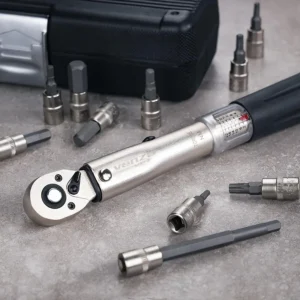
I use the Venzo Bicycle Bike 1/4 Inch Driver Torque Wrench Allen Key Tools Socket Set. This bike torque wrench kit covers 2 to 24 Newton meters, which handles every fastener on a road bike. Stem bolts, seatpost clamp, brake caliper bolts, derailleur limit screws, bottle cage bolts. All of it.
It is not the most expensive option on the market. It does not need to be. It is accurate, the range is right, and the socket set covers every hex size I have needed on the Domane. I keep it on the workbench and use it every time I touch a fastener.
Your carbon bike came with a torque specification sheet or the specs are printed directly on the components. Trek prints them right on the frame at each fastener point. Use those numbers. Do not guess.
The Chain
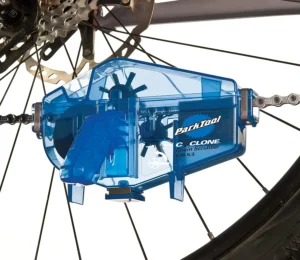
While I had the bike off the trainer I pulled the chain and ran it through the Park Tool CM-5.3 Cyclone Chain Scrubber. The chain was bone dry and stiff from three years of sitting. The CM-5.3 clamps around the chain and runs it through a solvent bath, cleaning the rollers and plates without removing the chain from the bike entirely.
After cleaning I let it dry completely before lubing.
Boeshield T9
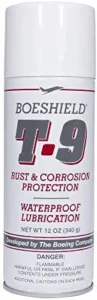
For lubrication I use Boeshield T9. It was developed by Boeing for aerospace applications, which is either the most reassuring or most over-engineered origin story for a bike lube depending on how you look at it.
T9 cleans, lubricates, and protects against rust and corrosion. It penetrates well, which makes it useful beyond just the chain. I use it on the pivot points of the brake calipers, the derailleur pulleys, and any other point that moves and needs to keep moving freely. A little goes a long way. On brake components especially, a very little goes a long way.
The Habit
Before every ride, or after any period of sitting, go through every fastener with your bike torque wrench. Check the torque. Clean the chain. Lube what needs lubing. Inspect the tires. Check the brakes.
It takes less than an hour and it tells you exactly what condition your carbon fiber bike is in before you ask it to perform.
I had not ridden the Domane in three years. When I finished the maintenance session every fastener was at spec, the chain was clean and lubricated, the brakes were moving freely, and the tires were holding air.
The bike was ready. Now I have no excuses.
The first ride is this week.